
What is the principle of sealing test?In-depth analysis allows you to understand the core technology
Welcome to our latest technology reveal journey. The question we are going to discuss today can be said to be very "tight" - what exactly is tightness testing?What is the principle of sealing test?Don't worry, sit tight, let's unravel this technical mystery step by step.
Sealing testing plays a vital role in modern industry and various production links.Imagine how terrifying it would be if your favorite beverage bottle, medical syringe, or car airbag had a tiny leak!Air leakage not only brings product quality problems, but also endangers the life safety of users.Therefore, sealing testing is particularly important.However, although this seemingly complex problem, the principles hidden behind it are actually not outrageous.Through in-depth exploration of various sealing testing methods and technologies, you will definitely discover the mysteries and fun involved.
In this article, we will gradually analyze the various methods of sealing testing, taking you from ignorance to understanding, from understanding to mastery, and from truly getting started with technology to becoming proficient.Let us uncover the mystery of this field together!
1. What is sealing test?
Leak testing refers to a range of methods and techniques used to determine the presence of leaks in a product, device or system.Simply put, this detection method is used to ensure that gases or liquids do not pass through a specific interface.Whether it is food packaging, medical supplies, or aerospace equipment, sealing testing is essential.
The basic principle of sealing testing is actually not complicated. It usually includes: applying a certain pressure, detecting pressure changes, or using a certain test medium to judge the sealing effect through these means.Different types of products and uses need to be tested according to different standards and specifications, so in actual operation, it is often necessary to choose the appropriate method based on specific conditions.
2. What are the commonly used sealing testing methods?
In industrial applications, commonly used sealing detection methods are mainly divided into two categories: gas detection and liquid detection.We can further subdivide it into the following methods:
- Compressed air testing method
- Helium detection method
- Underwater leak detection method
- bubble method
- electronic scanning method
Each of these methods has advantages and disadvantages and is suitable for different application scenarios.For example, the compressed air detection method is suitable for most low-pressure working conditions, while the helium detection method is more suitable for high-precision and high-sensitivity situations.It should be noted that various methods are not mutually exclusive and can often complement each other to achieve the best detection results.
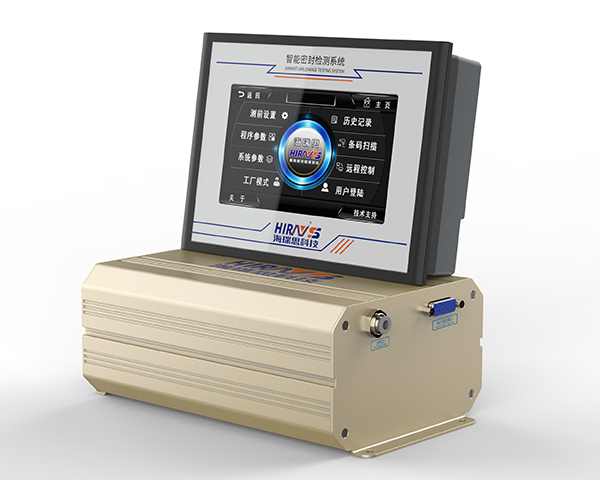
3. Compressed air detection method
The compressed air testing method is one of the most commonly used sealing testing methods. Its principle is to fill the inside of the test object with compressed air and then monitor changes in internal pressure to determine whether there is a leak.The advantages of this method are its simplicity, low cost, and suitability for most industrial applications.However, its sensitivity is relatively low, so it is usually used in situations with low accuracy requirements.
Specific operating steps generally include: sealing the product, filling it with compressed air, and then using a pressure sensor to monitor internal pressure changes.If the pressure drops beyond the preset value within a certain period of time, it can be determined that there is a leak.
4. Helium detection method
Helium detection method is a highly sensitive and high-precision sealing detection method.The principle is to use the small volume and high diffusivity of helium molecules to determine the sealing condition by detecting the leakage of helium.Helium detection method is commonly used in aerospace, high-precision equipment and other fields that require high reliability and accuracy.
In actual operation, the object to be detected is first wrapped in a sealed environment, then helium is injected, and then a helium detection instrument is used to detect leaks.If helium leakage is detected, the product is not tightly sealed.Although this method is more expensive, its high accuracy and reliability are unmatched by other methods.
5. Underwater leak detection method
The underwater leak detection method is an intuitive and simple detection method, especially suitable for preliminary inspection.The principle is to immerse the device under test in water and then observe whether bubbles emerge from a certain part of the device.The location of the bubble is the leak point.
The advantage of this method is that it is simple to operate and does not require complicated equipment, but its shortcomings are also obvious: it is not suitable for detection with high accuracy requirements and can only detect larger leaks.Underwater operation is not suitable for all products, especially those that are extremely sensitive to moisture.
6. Electronic scanning method
The electronic scanning method is a modern and efficient sealing detection method. Its principle is to scan the surface of the object through electronic equipment to detect sealing abnormalities.This method is often used in high-precision, high-tech fields such as the semiconductor industry and electronic component manufacturing.
In the specific operation, high-precision scanning equipment is used to comprehensively scan the object being tested. The detection equipment will transmit the data to the computer, and the analysis software will determine whether there is a sealing problem by comparing it with the preset standards.The advantage of the electronic scanning method is its high precision and efficiency, but the cost is higher.
in conclusion
In general, sealing testing is an important means to ensure product quality and user safety.Whether you are a technology fan or a novice who knows little about technology, through the full information in this article, I believe you have a deeper understanding of sealing testing.As you can see, whether it is the compressed air detection method, the high-precision helium detection method, or the simple and intuitive underwater leak detection method, each method has its unique application scenarios, advantages and disadvantages.
As a brand dedicated to providing high-quality sealing testing solutions, Hirays will continue to work hard in this field and bring you more cutting-edge technology sharing and solutions.If you have more questions or interest in sealing testing, you may wish to continue to follow us. We will continue to uncover more technical mysteries for you in the next technical discussion.Thank you for reading, I hope you have learned a lot!
-
2026.04.11Good News | Hirays Honored as "Most Investment-Worthy Enterprise" at 2026 AI Glasses China Tour
-
2026.04.11Why are more and more companies opting for RGA technology for power bank electrolyte leakage detection?
-
2026.03.30Commemorating the revolutionary martyrs and inheriting the red spirit | Record of hirays’s theme activity of walking to commemorate the martyrs’ cemetery
-
2026.03.20Starting from June, the sale of non-compliant power banks will be banned: many companies ignore this detection issue
-
2026.03.16After charging 70% in 5 minutes, how can the safety of the power battery be maintained?
-
2026.03.14Overcoming difficulties and showing responsibility, efficient delivery wins praise - a tribute to the four pioneer employees on the production front line
-
2026.03.03Comparison of mass spectrometry technology applications: How do Heris helium mass spectrometers and RGA series enable precision manufacturing?
-
2026.02.26Construction has started | hirays starts a new journey of struggle in 2026
-
2026.02.06Let’s work together to embark on a new journey | The 3rd hirays Fun Games was successfully held
