
How to perform air tightness testing?Comprehensive explanation of the steps and methods of air tightness testing
Hermetic testing is critical to a wide range of equipment and processes, from automotive to electronic equipment.However, when it comes to air tightness testing, ordinary people may immediately think of complicated laboratory equipment and technical experts.Fortunately, we have a professional company, Haris, dedicated to making air tightness testing simple and easy to understand.Whether you're a technical professional or just curious about the subject, it's easy to understand.Today, we will comprehensively explain the steps and methods of air tightness testing to ensure that your next inspection will no longer confuse you.
1. Preparation work
Before starting any air tightness inspection, preparation is very important.This includes the following steps: Make sure the object being tested is clean and dry.Any dirt or moisture will affect the accuracy of the test results.Appropriate testing equipment needs to be selected.There are a variety of air tightness testing equipment on the market, just choose the most suitable one according to your actual needs.Make sure all connecting parts are tight and not loose to avoid unnecessary errors.
2. Choose the appropriate detection method
There are many methods for air tightness detection, and different methods are suitable for different detection scenarios.Common ones include differential pressure method, bubble method and helium leak detection.The pressure difference method uses pressure difference to judge sealing and is suitable for most scenarios.The bubble rule is suitable for simpler scenarios, such as repairing car tires.The helium leak detection method is a high-precision detection suitable for electronic equipment with strict requirements.The key to this step is to choose the most appropriate method based on the actual scenario and needs.
3. Set detection parameters
As with any air tightness inspection, setting the appropriate inspection parameters is critical.Parameter settings include pressure, time and leakage standards.This requires technicians to make adjustments based on specific circumstances.If it is detected in a low-pressure environment, just use low-pressure parameters; while in a high-pressure environment, corresponding high-pressure parameters are required.In terms of time setting, it is generally set according to the size and sealing requirements of the product.Leakage standards refer to industry standards or product requirements.Accurate parameter settings can ensure the reliability of detection results.
4. Conduct preliminary testing
After everything is ready, conducting a preliminary inspection is a necessary step for most air tightness inspections.Preliminary inspection can help technicians understand the general equipment status and inspection environment.If the initial test results are satisfactory, subsequent detailed tests can be continued.If the results are not ideal, adjustments can be made based on preliminary results.For example, reset parameters, check equipment connection parts, etc.Preliminary testing is equivalent to allowing us to "warm up" before formal testing.
5. Formal testing
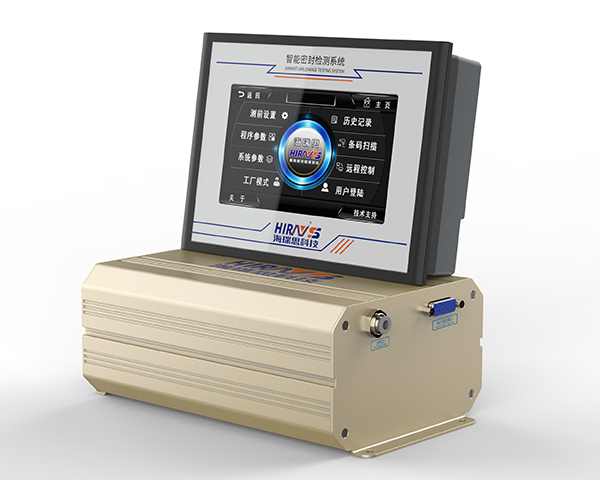
After preliminary testing and adjustments, formal testing begins.Precision operation and monitoring are involved here.Technicians need to pay close attention to the readings of the testing equipment and record all testing data.The inspection equipment provided by Haris is usually equipped with high-definition display and intelligent data recording function, so that the operator can clearly view and record any abnormal data during the inspection process.During this process, it is necessary to ensure that the environment is kept stable and external interference is avoided to ensure the credibility of the test results.
6. Result analysis
After the test is completed, the next step is to analyze the results.Haerisi's testing equipment usually comes with its own data analysis module, which can automatically generate detailed testing reports.Not only can it help technicians quickly understand the test results, but it can also provide guiding suggestions to help improve the air tightness of the product.For example, if a large leak occurs in a component, the source of the problem can be found through the data in the report and targeted repairs can be made.At the same time, the detection parameters can also be optimized to facilitate the next detection.
7. Report generation and archiving
The final step is to generate and archive the inspection report.Detailed test reports include all test data, parameter settings and analysis results.This is not only a summary of this inspection work, but also a reference for future inspection work.During the archiving process, the completeness and traceability of the reports are ensured.The testing equipment provided by Hirays usually comes with its own cloud storage function, allowing users to view and manage testing reports at any time.Not only save paper, but you can also access and share reports anytime and anywhere, improving work efficiency.
in conclusion
Air tightness testing sounds like a complicated professional field, but through the explanation of this article, I believe you already have a clear understanding.From preparation to selecting the appropriate detection method to final report generation and archiving, every step is critical.By using professional equipment like Haris, this process can be greatly simplified and the accuracy and reliability of the test results can be ensured.I hope that through this sharing, you will have a new understanding and perspective on air tightness testing, and you will no longer feel that it is an unattainable thing. On the contrary, you will be able to easily control it in actual work.
-
2026.04.11Good News | Hirays Honored as "Most Investment-Worthy Enterprise" at 2026 AI Glasses China Tour
-
2026.04.11Why are more and more companies opting for RGA technology for power bank electrolyte leakage detection?
-
2026.03.30Commemorating the revolutionary martyrs and inheriting the red spirit | Record of hirays’s theme activity of walking to commemorate the martyrs’ cemetery
-
2026.03.20Starting from June, the sale of non-compliant power banks will be banned: many companies ignore this detection issue
-
2026.03.16After charging 70% in 5 minutes, how can the safety of the power battery be maintained?
-
2026.03.14Overcoming difficulties and showing responsibility, efficient delivery wins praise - a tribute to the four pioneer employees on the production front line
-
2026.03.03Comparison of mass spectrometry technology applications: How do Heris helium mass spectrometers and RGA series enable precision manufacturing?
-
2026.02.26Construction has started | hirays starts a new journey of struggle in 2026
-
2026.02.06Let’s work together to embark on a new journey | The 3rd hirays Fun Games was successfully held
