
In our use of productsAir tightness testingWhen testing, the leakage rate of the product is usually used as the criterion for determining leakage.
Q: Why should leakage rate be used as the criterion?
A: Because the same product is manufactured by differentAir tightness testing equipmentDuring testing, the size of the fixture and product were different.If the pressure drop is used to judge, the upper limit of leakage of equipment A will be 50pa,BThe upper limit of equipment leakage is80paphenomenon, it is impossible to unify testing standards.
Leak rate formula
leakagerateformula:Q sccm=60(V×∆p)/(Patm×t) (Note: Q represents the leakage rate,QsccmIndicates that under standard atmospheric pressure,25Gas leakage rate at °C)
In the air tightness testing industry, the unit of leakage rate is generally:ml/min, so how is the formula for leakage rate obtained?
This requires usingthe followingtwo formulas:
Formula 1: Ideal gas equation of state
PV=nRT, The ideal gas equation of state is an equation of state that describes the relationship between pressure, volume, and temperature of an ideal gas in equilibrium.
p is the pressure (Pa), V is the gas volume (m³), T is the temperature (K), n is the amount of gas substance (mol), and R is the molar gas constant (also called the universal gas constant) (unit: J/(mol.K)).
The leakage of a product is related to factors such as pressure, volume, temperature, atmospheric pressure, and time. The leakage rate of a product refers to how much gas leaks per unit time during air tightness testing.
And we can know whether the product is leaking by measuring changes in pressure.
Formula 2:Flow rate calculation formula
Q=V/t, represents the gas flow rate through a certain container per unit time, using lettersQ means, V is the volume of the container, and t is the time.
Derivation process
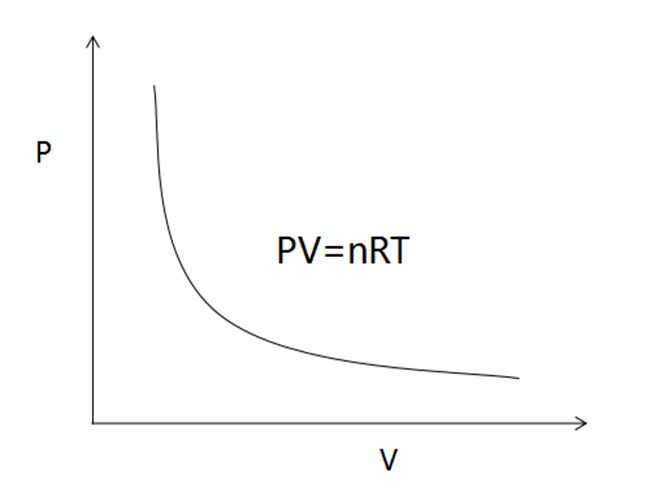
1. ideal gas equation of statePV=nRT, according to the formula, the following figure can be drawn:
2. Take two points on the curve as state points. According to the ideal gas state equation, the calculation formula of these two points is:PV=nRT;(P-∆p)(V+∆v)=nRT
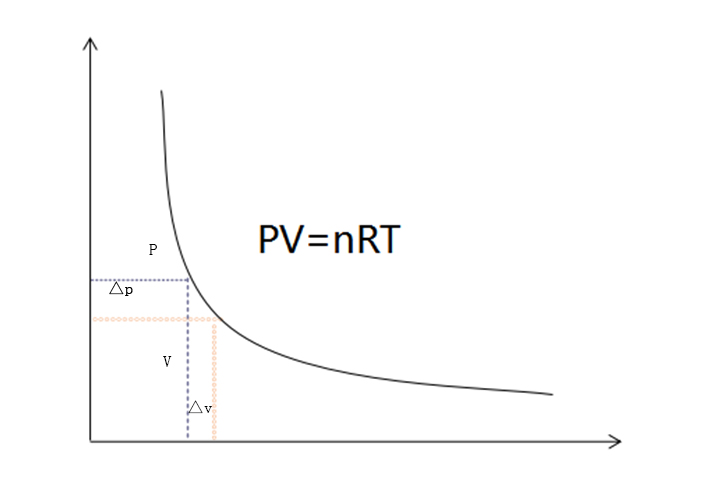
3. These two points are taken from different time points during the air tightness testing process of the same product, son and R remain unchanged. Assuming that the temperature T is constant, it can be concluded that PV=(P-Δp)(V+Δv);
4. By calculating the above formula: PΔv=V×Δp+Δp×Δv;
5. Assume that the two state points taken at that time are very close, that is, Δp and Δv are very small compared with P and V;
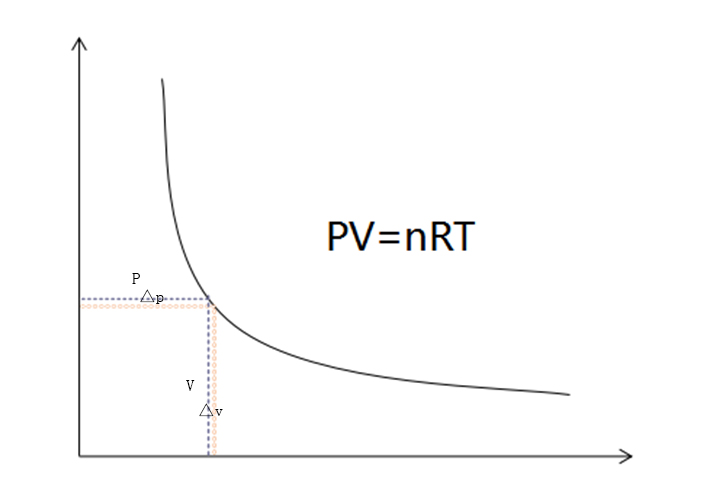
6. When these two points are infinitely close to each other, which is equivalent to coincidence, during the calculation process, they can beΔp and Δv are ignored, and the equation can be written as P×Δv=V×Δp
7. Transform the equation to get the formula:∆v=V×∆p/P
8. Calculation formula based on flow rateQ=V/t, Leakage rate Q=Δv/t=V×Δp/P×t
9. Replace the pressure with atmospheric pressure under standard conditions, and we getLeak rate formula for sccm results:
Qsccm=60(V×∆p)/(Patm×t)
As can be seen from the above, the formula isΔp is only true when it is very small. How small should it be?
Δp is much smaller than P, so small that it can be ignored.
Note:
Sccm: Standard flow value in liters per minute
Patm: standard atmospheric pressure;
t: test time;
Δp: pressure drop value;
V: The volume of the object being measured can be calculated based on the standard leak hole.
As can be seen from the above, the formula isΔp is only true when it is very small. How small should it be?
Δp is much smaller than P, so small that it can be ignored.
Note:
Sccm: standard liter per minute flow value;
Patm: standard atmospheric pressure, value is 101325pa;
t: test time, unit, seconds (s);
Δp: pressure drop value, unit Pa (pa);
V: The volume of the object being measured can be calculated based on the standard leak hole, in milliliters (ml).
If you are inconvenient to calculate during air inspection or feel that the calculation is too complicated, please don’t worry, Hirays has also prepared a calculator for you specifically for air tightness inspection.WeChat search applet"HRS Commonly Used Calculator" can be used.
Choose the right instrument and the test will not be tiring!More than 2,000 customers have witnessed the development of Hirays,More than fifty engineersAlways available.7 days fast delivery, is a commitment to you and a requirement to ourselves.Choosing Haris is a choiceStablizeandhigh quality。
-
2026.04.11Good News | Hirays Honored as "Most Investment-Worthy Enterprise" at 2026 AI Glasses China Tour
-
2026.04.11Why are more and more companies opting for RGA technology for power bank electrolyte leakage detection?
-
2026.03.30Commemorating the revolutionary martyrs and inheriting the red spirit | Record of hirays’s theme activity of walking to commemorate the martyrs’ cemetery
-
2026.03.20Starting from June, the sale of non-compliant power banks will be banned: many companies ignore this detection issue
-
2026.03.16After charging 70% in 5 minutes, how can the safety of the power battery be maintained?
-
2026.03.14Overcoming difficulties and showing responsibility, efficient delivery wins praise - a tribute to the four pioneer employees on the production front line
-
2026.03.03Comparison of mass spectrometry technology applications: How do Heris helium mass spectrometers and RGA series enable precision manufacturing?
-
2026.02.26Construction has started | hirays starts a new journey of struggle in 2026
-
2026.02.06Let’s work together to embark on a new journey | The 3rd hirays Fun Games was successfully held
