
The air tightness tester is a new type of non-destructive air tightness tester and sealing tester.It can be used to test air pressure attenuation leak detection, vacuum attenuation leak detection, mass flow test, burst test, and other air tightness leak detection and waterproof testing.
Air tightness leak meterThe system has built-in imported high-precision sensors, and the test accuracy can reach 0.01pa.Widely used in small household appliances industryWaterproof testing, air tightness leak detection in the valve and pipe fittings industry, waterproof testing of communication base station equipment, medical equipmentAir tightness testing, wire sealing testing, outdoor monitoring product sealing and quarantine, aluminum alloy die-casting product leakage testing, welding product leakage testing, and other products that require waterproofing, dustproofing and leakage.
Common air tight seal testing methods:
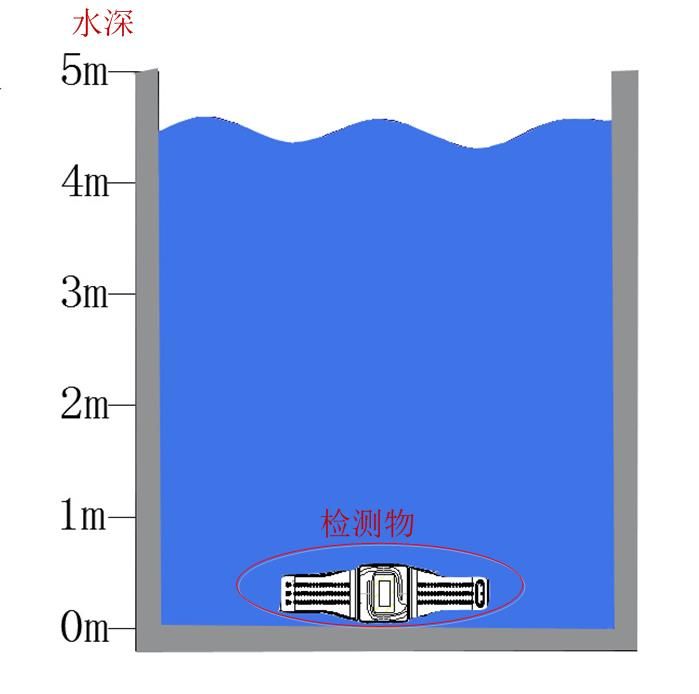
traditionalAir tightness testThe method is soaking in water (directly soaking in water): the water depth and soaking time correspond to each levelIP waterproof level test.Observe whether there is water inside the product as the criterion.
The disadvantage is that once water enters electronic products, it may cause irreparable damage to the components.Therefore, electronic products may not necessarily be suitable for traditional methods.
A is inefficient and the data is not quantified.
B The airtight leak detection efficiency is low and requires repeated disassembly, assembly, and verification.
C is not suitable for use in production lines for full inspection.
D is extremely dependent on human judgment and lacks rigor!
Traditional detection method (schematic diagram of direct soaking in water)
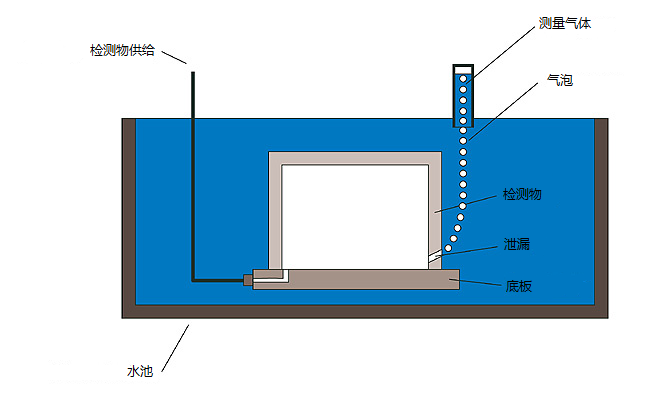
Air tightness leak detectionThe traditional detection method (indirect water immersion): pass a certain pressure of gas into the sealed workpiece cavity, sink the workpiece into water (or other liquids), and observe whether there are bubbles leaking out.Or apply soapy water on the surface of the workpiece and observe whether bubbles are formed.(The test efficiency of this method is not high. Human factors have a great impact on the leakage test results. There is no accuracy at all. The data cannot be quantified and it is inconvenient to track and determine the cause. It causes secondary pollution to the product and requires drying and wiping. The only advantage is that the leakage point can be found. This method is quite backward.) In many cases, very small bubbles are not easily detected by the naked eye.There is leakage but does not necessarily produce bubbles when there is a slight leakage:
A. Surface tension of water&– Water molecules may block leaks,No leaks, no bubbles。
B. In the case of extremely small leakage, gas molecules can be integrated into the water - no bubbles are generated.
C. Extremely dependent on human judgment and lacks rigor!!
Schematic diagram of traditional detection method (indirect soaking in water)
The following distinctions can be made according to detection methods:
A leak test pressure drop method
1. Direct leak detection (both positive and negative pressure forms)
2. Direct detection of differential pressure (positive and negative pressure in two forms)
3. Indirect leakage detection (both positive and negative pressure forms)
4. Indirect detection of differential pressure (positive and negative pressure in two forms)
B. Flow rate of air tightness detectorAir tightness leak detectionWay
Introduction to the working principle of new non-destructive gas detection:
Air tightness leak detector detection system, the pressure drop method, as the name suggests, through the equal amount of air intake, pressure stabilization, detection, and then detection of gas pressure and volume changes, the precision tester system undergoes a series of sampling, calculation, and analysis to obtain the leakage rate, leakage value, etc., and based on these data, a judgment of OK or NG is made.Mainly used in waterproof testing of small household appliances and air tightness testing of medical devices , Leak test of stainless steel containers.The leakage detection principle of this method is as follows: Inject a certain pressure and a certain volume of gas into a sealed workpiece cavity, wait for a period of time to stabilize the pressure, then cut off the compressed air supply to the component (the valve is closed), and measure the pressure change after a predetermined measurement time.If a leak is present, the sensing pressure will drop.Its principle and leak detection method are shown in the figure below
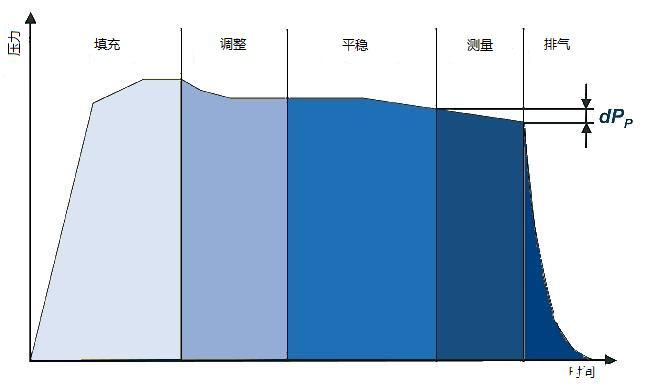
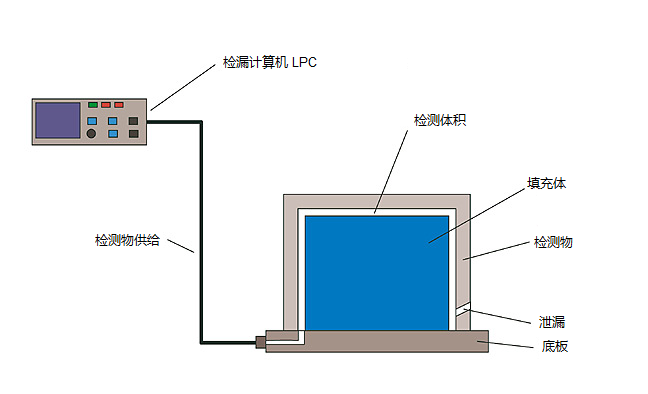
Direct leak detection method of pressure drop method (positive and negative pressure)
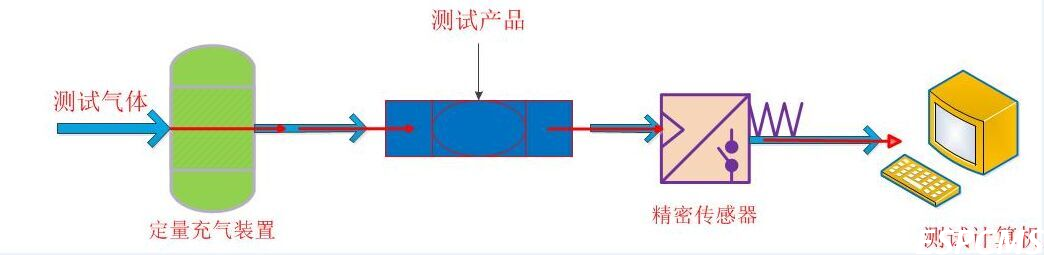
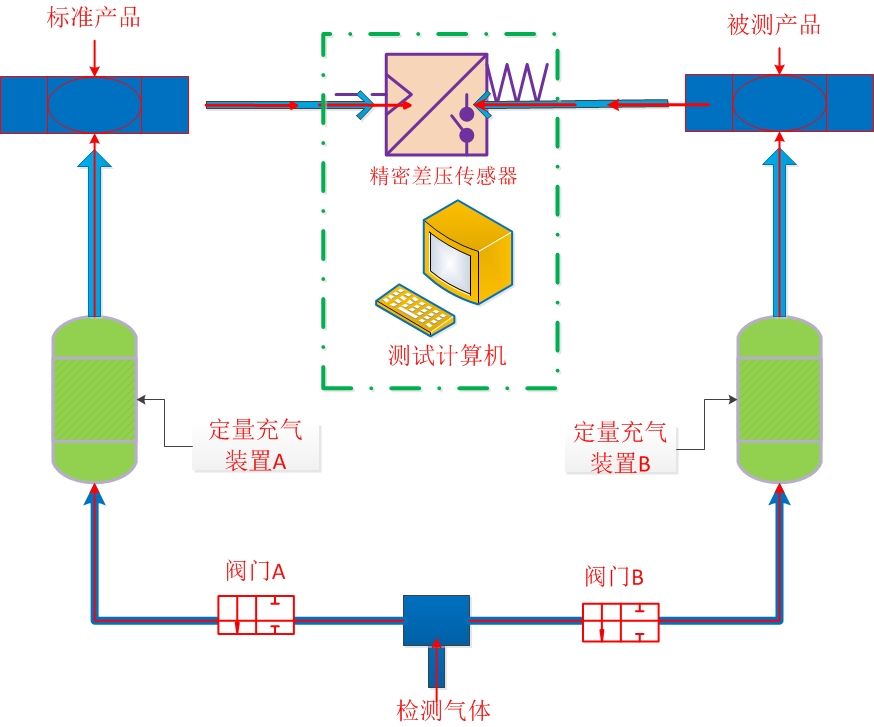
Pressure drop method---differential pressure (positive and negative pressure) direct air tightness leak detection method
Mainly used for sealing testing of valves and pipe fittings, air tightness leak testing of stainless steel welded products, and sand hole micro-leak testing of aluminum alloy die-casting products.The principle is similar to the pressure drop method, but the method is better.Pour a certain pressure of gas into the sealed workpiece cavity, and at the same time, pass the same pressure of gas into a standard tank, and wait for a while to observe the pressure in the standard tank and the workpiece, and the tiny pressure difference generated on the differential pressure sensor due to leakage.The leak detector quantitatively calculates the air leakage of the object under test based on the output changes of the differential pressure sensor.The existence of the benchmark minimizes the impact of testing when the external environment and the work itself are different.Overcame the shortcomings of the above methods and improvedAir tightness testefficiency, accuracy and reliability.
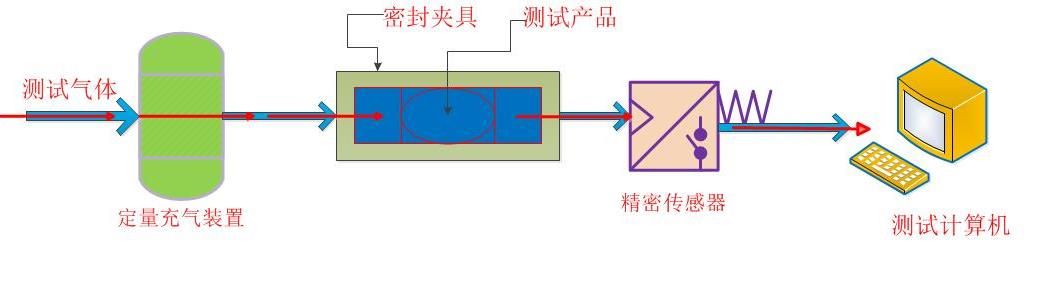
Suitable for testing situations with low requirements.For example: IP waterproof testing, such as waterproof testing of outdoor electrical products, the method is to press one side of the cavity, collect the leaked gas on the other side (cavity), and reduce the volume of the cavity as much as possible to increase the rate of pressure change per unit leakage.
Indirect detection between pressure drop method (positive and negative pressure)
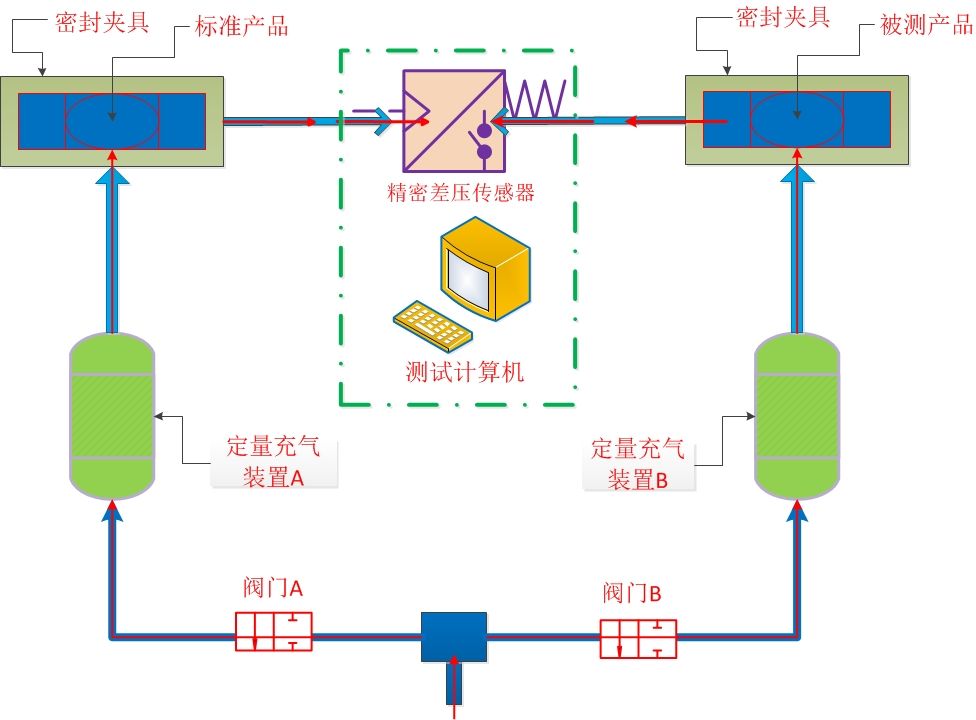
Indirect detection of differential pressure (positive and negative pressure) by pressure drop method
It is mainly used for sealing detection of valves and pipe fittings, leakage detection of stainless steel welding products, and blistering microleakage testing of aluminum alloy die-casting products.The principle is similar to the pressure drop method, but the method is better.Pour a certain pressure of gas into the sealed workpiece cavity, and at the same time, pass the same pressure of gas into a standard tank, and wait for a while to observe the pressure in the standard tank and the workpiece, and the tiny pressure difference generated on the differential pressure sensor due to leakage.The air tightness detector quantitatively calculates the air leakage of the object under test based on the output changes of the differential pressure sensor.The existence of the benchmark minimizes the impact of testing when the external environment and the work itself are different.It overcomes the shortcomings of the above methods and improves the efficiency, accuracy and reliability of detection.
Suitable for testing situations with low requirements.For example: IP level waterproof testing, such as outdoor electrical products, the method is to press on one side of the cavity, collect leakage gas on the other side (cavity) and reduce the volume of the cavity as much as possible to increase the rate of pressure change per unit leakage.
Air tightness leak detectorThe flow detection method uses the method of instantaneous loss of flow to conduct a sealing test on the product being tested.mainAir tightness testingThe principle is that the sensor directly detects the leakage rate of the product and displays it in real time, which basically eliminates the need for leakage in the original pressure leakage test method.leakTest accumulation time, this product has a fast leakage test speed and can directly display the leakage unit. It is suitable for products that require testing efficiency.The measurement signal of flow measurement has nothing to do with the test volume, unlike pressure measurement where the measurement signal decreases as the test volume increases.This is an advantage during calibration. The measurement signal corresponds directly to the gas flow through the leak calibrator. The exact test volume no longer needs to be known during the calibration process, nor does it need to be considered to determine the leak rate.The volume flow method is generally not used for leak detection but for flow control, such as flow monitoring of free channels in a gas system before performing a pressure reduction leak test using the same measuring element (differential pressure sensor).In the mass flow detection method, the test signal is not only independent of the test volume nor the test pressure, but directly corresponds to the standard leakage rate Std cm3/min, unlike the pressure drop method measurement where the allowable leakage rate must be calculated.
The volume flow method is generally not used for air tightness testing but for flow control, such as flow monitoring of free channels in a gas system before using the same measuring element (differential pressure sensor) to perform a pressure reduction leak test.
-
2026.04.11Good News | Hirays Honored as "Most Investment-Worthy Enterprise" at 2026 AI Glasses China Tour
-
2026.04.11Why are more and more companies opting for RGA technology for power bank electrolyte leakage detection?
-
2026.03.30Commemorating the revolutionary martyrs and inheriting the red spirit | Record of hirays’s theme activity of walking to commemorate the martyrs’ cemetery
-
2026.03.20Starting from June, the sale of non-compliant power banks will be banned: many companies ignore this detection issue
-
2026.03.16After charging 70% in 5 minutes, how can the safety of the power battery be maintained?
-
2026.03.14Overcoming difficulties and showing responsibility, efficient delivery wins praise - a tribute to the four pioneer employees on the production front line
-
2026.03.03Comparison of mass spectrometry technology applications: How do Heris helium mass spectrometers and RGA series enable precision manufacturing?
-
2026.02.26Construction has started | hirays starts a new journey of struggle in 2026
-
2026.02.06Let’s work together to embark on a new journey | The 3rd hirays Fun Games was successfully held
