
Detailed explanation of the steps for using the air tightness tester to help you easily master testing skills
In modern industrial production, the sealing performance of products is not only related to product quality, but also affects consumer experience and safety.In order to ensure the air tightness of products, air tightness detectors are widely used.Among many brands, Hairisi has become the leader in the industry with its high precision and reliability.However, users who are using an air tightness tester for the first time may find the process complicated.This article will introduce you in detail how to use the air tightness tester, allowing you to easily master the testing skills and ensure the air tightness of the product.We hope that this detailed introduction to the usage steps can provide you with real help and make you more comfortable in operation.
1. Understand the basic components of the air tightness detector
To successfully use an air tightness detector, you first need to understand its basic structure.Usually, the Hairis air tightness detector consists of four main parts: the host computer, the measurement probe, the connecting pipe and the control software.The host is the core of the entire system, processing all data and instructions; the measurement probe is the part connected to the object to be measured and directly contacts the object to be measured; the connecting pipe is used to transmit gas or liquid; the control software can perform real-time monitoring and management of data on the computer side.Once we are familiar with these components, we can operate the equipment more smoothly in the next steps.
2. Initial settings and preparations
Before conducting air tightness testing, preliminary settings and preparations for the detector need to be made.Ensure that the equipment matches the working environment, including ambient temperature, humidity, etc.Then, correctly connect the measuring probe to the object being measured to ensure good sealing; next, connect the connecting pipe to the air tightness detector host to ensure there is no leakage in the connection.Start the control software and set relevant parameters, such as pressure value, detection time, detection standards, etc., according to the characteristics of the object to be measured and the detection standards.After completing these preparations, the device can enter the test-ready state.
3. Carry out air tightness test
After completing the initial settings, the actual air tightness test can be carried out.According to the set parameters, inflate or inject liquid into the object to be measured, usually through a measuring probe.As gas or liquid is injected, the system will automatically monitor pressure changes and record relevant data.When the injection reaches the set pressure, it enters the pressure maintaining stage. This stage is used to observe whether the pressure drops significantly.If the pressure remains stable, it means the air tightness of the object being measured is good; if it drops significantly, it means there is a leakage problem.Special attention should be paid to this step. According to different test standards, the holding time may be different.
4. Data analysis and evaluation
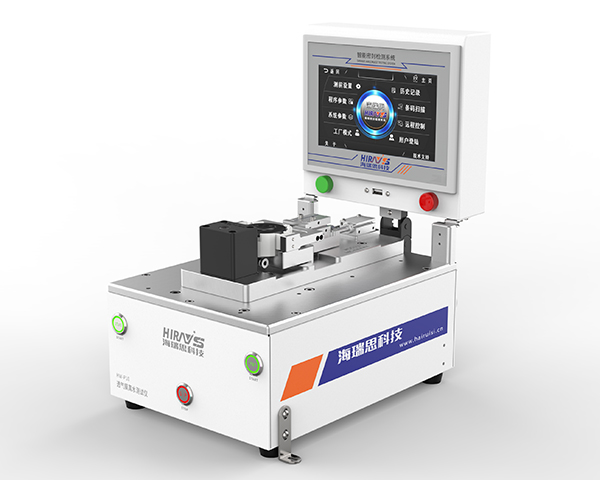
After completing the detection, the system will generate corresponding data and reports.Using the control software of the Hairis air tightness detector, these data can be analyzed in detail, such as leakage rate, pressure change curve, etc.By analyzing this data, problem areas can be pinpointed and corresponding improvement measures made.During the evaluation phase, multiple products should also be tested to ensure data reliability and consistency.Through rigorous data analysis and evaluation, it can be ensured that the air tightness of each batch of products during the production process meets the standards.
5. Maintenance and maintenance
In order to ensure the long-term stable operation of the air tightness detector, regular maintenance and upkeep are essential.The measuring probe and connecting pipes should be checked regularly to ensure that they are not damaged or aged and replaced if necessary.The host part also requires regular calibration and maintenance to ensure data accuracy.Control software also needs to be updated regularly to ensure it has the latest functionality and performance.Through regular maintenance and upkeep, the service life of the equipment can be extended and the failure rate can be greatly reduced.
6. Training and safe operation
In addition to equipment maintenance, user training is also very important.Operators need to receive systematic training to understand the structure, usage steps and precautions of the equipment.It is also necessary to follow relevant safety operating procedures to ensure that no accidents occur during operation.During the training process, special emphasis should be placed on handling methods in emergency situations to avoid equipment damage or safety accidents caused by operational errors.Through comprehensive training, the technical level of operators can be improved to ensure the smooth progress of the inspection process.
in conclusion
Through the above six steps, we have introduced in detail how to use the Hairis air tightness detector.Whether you are a beginner or an experienced operator, you can easily master the skills of air tightness testing as long as you follow the steps in this article.We hope that you can flexibly use this knowledge in actual use to ensure that the air tightness of each product is optimal.If you have more questions about the air tightness detector, please contact us and we will serve you wholeheartedly.
-
2026.03.30Commemorating the revolutionary martyrs and inheriting the red spirit | Record of hirays’s theme activity of walking to commemorate the martyrs’ cemetery
-
2026.03.20Starting from June, the sale of non-compliant power banks will be banned: many companies ignore this detection issue
-
2026.03.16After charging 70% in 5 minutes, how can the safety of the power battery be maintained?
-
2026.03.14Overcoming difficulties and showing responsibility, efficient delivery wins praise - a tribute to the four pioneer employees on the production front line
-
2026.03.03Comparison of mass spectrometry technology applications: How do Heris helium mass spectrometers and RGA series enable precision manufacturing?
-
2026.02.26Construction has started | hirays starts a new journey of struggle in 2026
-
2026.02.06Let’s work together to embark on a new journey | The 3rd hirays Fun Games was successfully held
-
2026.02.05Riding horses side by side, working together to move forward | hirays year-end ceremony and awards ceremony concluded successfully
-
2026.02.05How does a smart watch pass the waterproof level?In-depth analysis of hiraysi’s full-link air-tightness detection solution