
How to test the tightness?
How to test tightness
- The traditionally used bubble method: Pour a certain pressure of gas into the sealed workpiece cavity, immerse the workpiece into water or other liquids, and observe whether there are bubbles overflowing. If there are air leaks, it is considered unsealed. If there are no bubbles, it means there is no air leaking out, and it is sealed.Or apply soapy water on the surface of the workpiece and observe whether bubbles are formed.If bubbles are generated, air is leaking from the cavity, which means it is not sealed.This kind of seal detection method is backward, pollutes the product, is inefficient, and cannot be automated. Tiny air leaks cannot be seen by the human eye. Many products cannot be inflated inside, and the seal cannot be detected for types that cannot be inflated.There are great limitations
- Pressure drop method: Pour a certain pressure of gas into a closed workpiece cavity, wait for a period of time, and then detect the pressure of the gas again to see if the pressure has dropped, and judge whether there is a leak based on the change in pressure.If there is leakage, it must be unsealed (backward, extremely low efficiency, and lowest sensitivity)
- Pressure difference method: The principle is similar to the pressure drop method, but this method detects sealing better.Pour a certain pressure of gas into the sealed workpiece cavity, and at the same time, pump the same pressure of gas into a standard tank, and wait for a period of time to observe the pressure difference between the standard tank and the workpiece.This is more accurate than the pressure drop method, and it can eliminate pressure deviations caused by changes in ambient temperature.However, the resolution of existing differential pressure gauges on the market is only 100~1000pa (the sensitivity has been improved, and the seal detection efficiency is not high)
- Leakage collection method: Suitable for sealing detection of valve products, one side (cavity) is pressurized, the other side (cavity) collects leaked gas and reduces the cavity volume as much as possible to increase the rate of pressure change per unit leakage.Leak detection efficiency is average.
- Ultrasonic detection method: The principle is that the leak point will generate ultrasonic waves, and the leak point can be found using an ultrasonic detector.This is suitable for detection of leak points in gas pipelines.(The accuracy is acceptable. The minimum leakage velocity that can be detected is about 10~20 cubic millimeters/second, or 10^-3 cubic meters*Pa/second. The efficiency is average. All surfaces must be scanned and detected.)
- Halogen gas leak detection method: Pour halogen gas at a certain pressure into a sealed workpiece cavity, and use a halogen detector outside the workpiece to detect whether there is halogen gas leakage.(The accuracy is acceptable. The minimum leak speed that can be detected is about 10 to 20 cubic millimeters/second. The efficiency is average. All surfaces must be scanned and detected.) Hydrogen-helium leak detection method: The principle is similar to the halogen gas leak detection method. The difference is that hydrogen-helium gas with smaller molecular weight and faster movement speed is used, so the sensitivity is higher.Pour helium gas at a certain pressure into a sealed workpiece cavity, and then use a helium mass spectrometer to detect whether there is leakage of hydrogen and helium elements around the cavity of the workpiece. This is the method currently used for high-precision leak detection. Compared with the previous methods, the accuracy is much improved. Of course, the cost is also high.The seal detection efficiency is not high and is not suitable for use on large-scale seal detection production lines. (The highest sensitivity is that in vacuum mode, leakage of more than 100 million gas molecules per second can be detected, which is about 5 cubic microns/second, or 10 at standard atmospheric pressure.^-13 cubic meters*Pa/second, if in atmospheric mode, the sensitivity is reduced by 4 orders of magnitude, about 0.05 cubic millimeters/second.Not only is the equipment expensive, but it also requires expensive helium consumption, and a vacuum pump must be used to scan and detect all surfaces.)
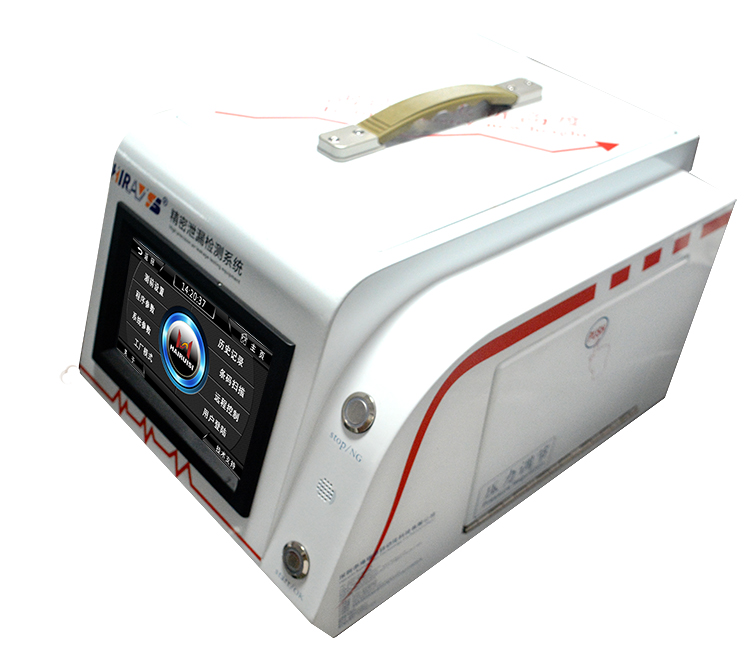
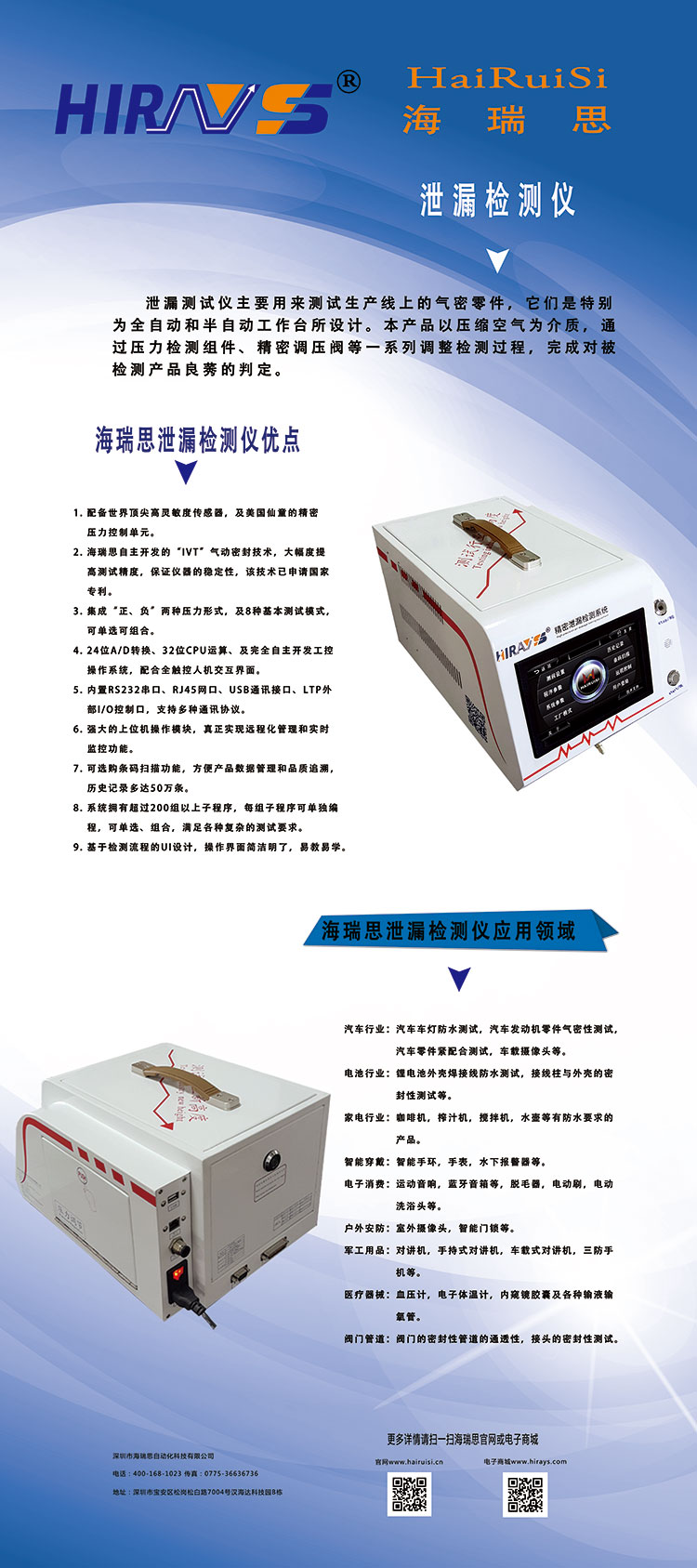
- So is there any leak detection equipment that has a detection sensitivity close to the hydrogen-helium leak detection method, is cheap, uses a more efficient and convenient method, and has good sealing performance detection stability?Yes, this contradiction can be solved by using our company's sealing and leak detection equipment.The picture below is our company's waterproof performance test and sealing performance test of outdoor cameras.Hiraysi Automation Technology Co., Ltd.
Recommended News
-
2026.04.11Good News | Hirays Honored as "Most Investment-Worthy Enterprise" at 2026 AI Glasses China Tour
-
2026.04.11Why are more and more companies opting for RGA technology for power bank electrolyte leakage detection?
-
2026.03.30Commemorating the revolutionary martyrs and inheriting the red spirit | Record of hirays’s theme activity of walking to commemorate the martyrs’ cemetery
-
2026.03.20Starting from June, the sale of non-compliant power banks will be banned: many companies ignore this detection issue
-
2026.03.16After charging 70% in 5 minutes, how can the safety of the power battery be maintained?
-
2026.03.14Overcoming difficulties and showing responsibility, efficient delivery wins praise - a tribute to the four pioneer employees on the production front line
-
2026.03.03Comparison of mass spectrometry technology applications: How do Heris helium mass spectrometers and RGA series enable precision manufacturing?
-
2026.02.26Construction has started | hirays starts a new journey of struggle in 2026
-
2026.02.06Let’s work together to embark on a new journey | The 3rd hirays Fun Games was successfully held
