
How to perform air tightness testing?—A step-by-step guide to detailed steps for air tightness testing
Air tightness testing is an important method to ensure that no gas leaks occur in products or systems.Whether in the automotive, aerospace, medical device or other industries, air tightness testing is critical to product quality and reliability.In this article, we’ll walk you through how to perform an air tightness test to help you master this important technical skill.As a leading manufacturer of air tightness testing equipment, Hairis will provide you with first-class equipment and support to ensure that your testing process is efficient and accurate.This article is not only useful for technicians, but also for beginners who want to understand or learn air tightness testing. I hope everyone can gain something from the reading process.
1. Preparation
Before conducting air tightness testing, sufficient preparations need to be made.This step is crucial because it will directly affect the subsequent testing process and results.Make sure the testing equipment and tools you use are in good condition, including air tightness testers, pipes, connections, etc.Understand and be familiar with the technical parameters and design requirements of the product to be tested. For some complex systems, you may need to consult product manuals or design documents.It is also necessary to ensure the stability of the detection environment, such as temperature, humidity, etc., need to be controlled within a reasonable range.Provide training to test operators to ensure that they are familiar with equipment operation and testing procedures, thereby reducing problems caused by operational errors during actual testing.
2. Equipment calibration
Equipment calibration is a key step in air tightness testing, which can ensure the accuracy and reliability of testing data.You need to perform a zero point calibration, which is to set the initial value of the device to zero without any load connected.Then, perform a standard air source calibration to ensure that the pressure source you are using can provide accurate and stable air pressure.This step usually requires the use of a standard gas source and a calibration device.Perform a leak calibration, a step in which known leak quantities are entered into the test system to ensure that the equipment can accurately detect a specific amount of gas leak.With these calibration steps, you can ensure your data is true and reliable throughout the entire inspection process.
3. Connect the object under test
After the equipment calibration is completed, the next step is to connect the object under test to the detection equipment.The operating steps must be carried out strictly in accordance with the guidelines of the product manual. First, ensure that the connection between the object to be tested and the testing equipment is firm and well-sealed.Use appropriate connecting pipes and joints, and ensure there are no gas leaks at the connections through tightening methods or sealing tests.Systems with complex designs and multiple connections may require step-by-step connections and inspections.Special attention should be paid to not allowing any foreign matter to enter the connecting pipe or detection system during the connection process to avoid affecting the detection results.After the connection is completed, perform a pre-test to ensure that the entire system is in a detectable state.
4. Start testing
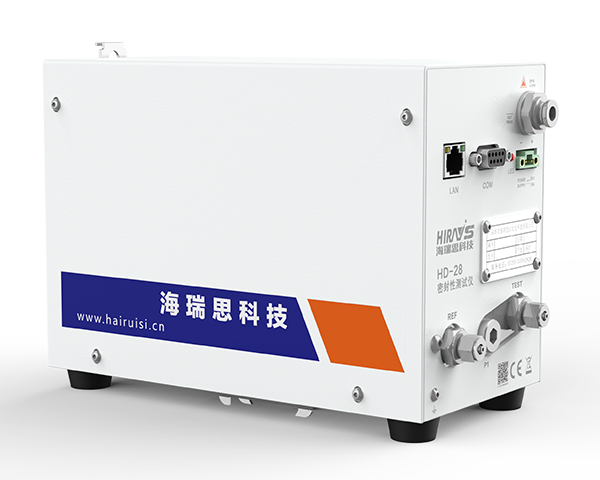
Once all preparations have been completed and the system has been connected, the actual air tightness test can begin.Start the air tightness tester according to the set detection procedure, and gradually apply air pressure to the object to be tested to ensure that the air pressure reaches the design parameters.Keep it for a period of time and observe the pressure changes on the detection instrument or computer interface.If the pressure remains stable, it means the airtightness of the object to be tested is good.If the pressure drops, it means there is a gas leak, and the leak point needs to be found through a leak detection device or other methods.To ensure the accuracy of results, multiple tests are often required, especially in certain demanding industries such as aerospace and medical devices.Record each inspection data and analyze the data to better understand the air tightness of the object to be tested.
5. Analysis and reporting
After completing multiple inspections, the final step is to analyze the inspection data and generate an inspection report.Data analysis can be performed using automated tools or manual methods. It mainly compares and analyzes data under different test conditions to determine the air tightness level of the object to be tested.Based on the analysis results, a detailed test report can be generated. The report content should include a description of the test equipment and methods, data records of each test, air tightness analysis results and conclusions.For products found to be leaking, the report should identify the location and possible cause of the leak, and provide recommendations for repair.Submit reports to relevant departments or customers as a basis for product quality control and improvement.
in conclusion
Through the detailed steps above, you already know how to perform air tightness testing.Air tightness testing is a key part of ensuring product quality. Scientific testing steps and precise analysis methods can help you quickly discover and solve gas leakage problems.As the industry's leading manufacturer of air tightness testing equipment, Hairis is committed to providing users with the highest quality testing equipment and solutions.I hope this article can help you better understand and apply air tightness detection technology, thereby improving product reliability and market competitiveness.Thank you for reading. I believe that through continuous learning and practice, you will achieve better results in the field of air tightness testing.
-
2026.03.30Commemorating the revolutionary martyrs and inheriting the red spirit | Record of hirays’s theme activity of walking to commemorate the martyrs’ cemetery
-
2026.03.20Starting from June, the sale of non-compliant power banks will be banned: many companies ignore this detection issue
-
2026.03.16After charging 70% in 5 minutes, how can the safety of the power battery be maintained?
-
2026.03.14Overcoming difficulties and showing responsibility, efficient delivery wins praise - a tribute to the four pioneer employees on the production front line
-
2026.03.03Comparison of mass spectrometry technology applications: How do Heris helium mass spectrometers and RGA series enable precision manufacturing?
-
2026.02.26Construction has started | hirays starts a new journey of struggle in 2026
-
2026.02.06Let’s work together to embark on a new journey | The 3rd hirays Fun Games was successfully held
-
2026.02.05Riding horses side by side, working together to move forward | hirays year-end ceremony and awards ceremony concluded successfully
-
2026.02.05How does a smart watch pass the waterproof level?In-depth analysis of hiraysi’s full-link air-tightness detection solution
