
The power bank industry has just seen two major policy moves:
On April 3, 2026, the mandatory national standard GB 47372—2026, Safety Technical Specification for Power Bank, was officially released;
On May 25, 2026, the Certification and Accreditation Administration of China (CNCA) issued the Implementation Rules for Compulsory Product Certification — Power Banks, Lithium-Ion Cells and Battery Packs (Trial) (CNCA-C09-02:2026).
Together, these move the industry into an era of dual regulation — a new national standard plus revised CCC (3C) certification. With the revised CCC rules now in place, the new national standard has concrete, explicit requirements for how it will be enforced.
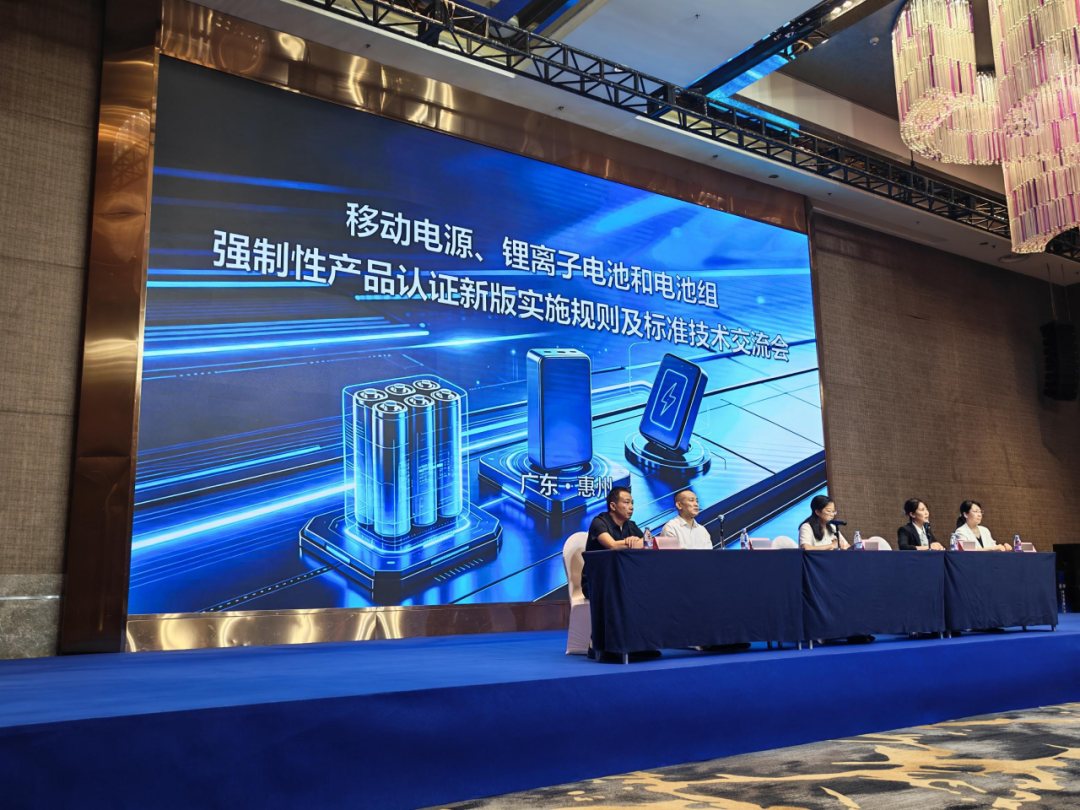
On June 10, 2026, the China Quality Certification Centre (CQC) held a technical exchange session in Huizhou on the new implementation rules and standards for compulsory certification of power banks, lithium-ion cells and battery packs, interpreting both the new national standard and the revised CCC requirements.
For power bank manufacturers, the practical consequence is this: from April 1, 2027, all relevant products must hold certification under the revised rules before they can be placed on the market.
With less than a year left on the clock, certification lead time, line retrofits, and — above all — building high-precision electrolyte leak detection capability for safety-critical items all have to move fast.
New CCC Rules Are Out: Complete the Certificate Switch Before April 2027
The revised CCC certification is the key mechanism that verifies whether a product genuinely meets the new national standard.
For power bank manufacturers, four things are non-negotiable:
Product R&D must comply with GB 47372;
Products must pass CCC certification before market entry;
Factory production processes are subject to certification audits;
Products remain subject to post-market surveillance spot checks.
Miss any one, and the chain breaks.
One date matters most: the revised implementation rules take effect on April 1, 2027. Companies still certifying under the old rules will later have to convert to the revised requirements anyway — otherwise they face the added cost of retesting, repeat factory audits, and re-review.
For companies that have not yet started the certification process, planning the certification route directly against the revised rules is now the more forward-looking choice.
The Revised CCC Rules Explicitly Require an Electrolyte Leak Detection Process
Compared with previous certification requirements, one of the biggest changes in the revised rules is that electrolyte leak detection is now explicitly mandated.
The 2026 rules make 100% in-line electrolyte leak inspection on volume-production lines, equipment control, and data traceability mandatory clauses in factory on-site audits — a core checkpoint of the factory review.
In the Factory Quality Assurance Capability Requirements, Clause 19.1.2 stipulates that an enterprise shall establish a reasonable electrolyte leak detection process based on its product process. Specifically:
Products built from pouch cells shall undergo electrolyte leak detection;
Battery packs using prismatic/hard-shell cells that are laser-welded on the cell body shall also undergo electrolyte leak detection.
The implication is clear: electrolyte leak detection is no longer a voluntary in-house quality measure. It is now a key audit item under the revised CCC certification.
Certification bodies will not only review product test results. They will also check specifically:
Whether a leak detection process has been established;
Whether the inspection is actually performed;
Whether test records exist;
Whether test data are traceable;
Whether a complete quality closed loop is in place.
Leak detection capability determines whether electrolyte leakage risk can genuinely be found — and that, in turn, directly affects whether a company passes the revised CCC audit.
Why Mass Spectrometry Is Essential for Electrolyte Leak Detection
The revised rules list five detection methods:
Positive-pressure leak testing
Negative-pressure leak testing
VOC detection
Helium detection
Mass spectrometry detection
All five appear valid on paper. But go back to what a leak actually is: what escapes is neither air nor helium — it is electrolyte vapor. The decisive question is whether a method can detect the electrolyte itself.
01 | Positive-/Negative-Pressure Testing: Misses Micro-Leaks and Can Damage the Cell
Sensitivity is relatively low, so micro-leaks go undetected entirely. Readings are highly susceptible to temperature and deformation effects, producing frequent false calls. Once the housing is closed, cell deformation can no longer be assessed.
More seriously, the positive-/negative-pressure cycle itself can damage the cell, introducing additional scrap risk.
02 | VOC Detection: Prone to Interference, High False-Call Rate
It is easily disturbed by adhesives, cleaning agents and ambient odors, driving a very high false-call rate. Sensitivity is insufficient, so tiny leaks cannot be detected precisely.
03 | Helium Detection: Costly Consumables, Missed Leaks
Accuracy is excellent, but the method requires charging an additional helium tracer gas. Consumables are expensive and operating costs are high. Electrolyte can also trap the helium, so real leaks are easily missed.
04 | RGA Quadrupole Mass Spectrometry: The Compliance-Ready Choice for Power Banks
Quadrupole mass spectrometry directly ionizes gas molecules and captures electrolyte-specific characteristic ions with precision, delivering both qualitative and quantitative detection.
Fingerprint-level identification: locks onto the electrolyte's exclusive m/z characteristic peaks, screening out workshop background gases — no false calls, no missed leaks;
High detection accuracy: leak detection sensitivity down to 1×10⁻⁸ Pa·m³/s, pinpointing micron-scale leak paths;
Non-destructive testing: avoids the cell damage inherent in conventional methods, exposing every micro-leak and lifting end-of-line yield;
No tracer gas: no tracer gas and zero consumables for the entire run, sharply lowering long-term operating cost;
Closed-loop data traceability: supports test-data storage and MES integration, fitting the new national standard's full workflow of quality traceability, process optimization, and compliance audit.
Of the five routes, therefore, RGA is currently the stronger technology path for the electrolyte leak detection required by the revised CCC rules.
Why Choose HIRAYS?
Power-Battery-Grade Validation, the Choice of Leading Customers
As a National High-Tech Enterprise with deep roots in precision inspection, HIRAYS has taken quadrupole mass spectrometry RGA technology validated against the demanding standards of traction batteries and applied it to power bank testing. With accuracy and stability far beyond conventional 3C inspection practice, this cross-domain transfer sets a new benchmark for consumer-electronics testing.
Deep Industry Track Record, a Partner You Can Rely On
18 years in precision inspection, long-term service to leading traction-battery and 3C companies. An in-house R&D team, owned production bases, and a nationwide service network give us sustained iteration capability and volume-delivery capacity — a stable, long-term foundation for customers.
Core Technology Under Our Own Control, for More Reliable Accuracy
The quadrupole, ion source, vacuum system and other core components are all developed in-house and fully controllable, with detection accuracy on par with imported equipment. The m/z algorithm is specifically optimized for lithium-battery electrolyte scenarios, identifying trace leaks precisely and cutting missed leaks and false calls at the source — for more accurate, more stable results.
Built for Volume Production: Efficient, Stable, Easy to Deploy
The standardized RGA solution supports 7×24 continuous in-line testing with dual-station, dual-chamber cyclic operation, adapting quickly to different lines for seamless volume-production rollout. Designed for harsh battery-production conditions, its anti-interference and contamination-resistant design greatly reduces false calls and maintenance downtime, keeping lines running efficiently and stably over the long term.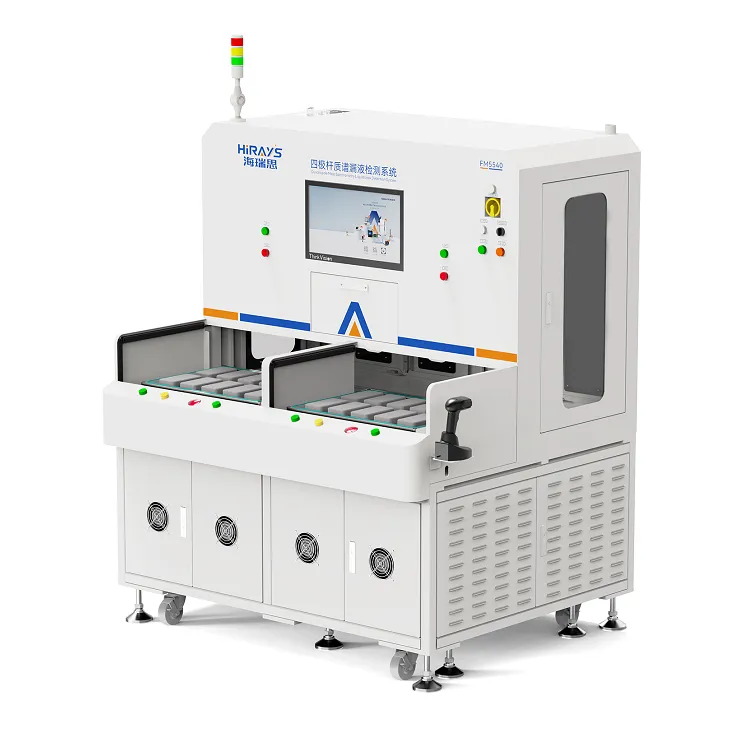
⬆ RGA electrolyte leak detection system for power banks under the new national standard
No Consumables, No Tracer Gas — Long-Term Cost Reduction
No helium or other tracer gas, zero consumables, no recurring material cost — a complete answer to the high-consumables pain point of conventional leak detection. Modular design keeps operation and maintenance simple, lowering total cost of ownership and helping volume production cut cost and raise throughput.
One-Stop Full-Chain Service: Compliance and Volume Production in One Step
Localized one-stop service covering the full flow — sample validation, volume-production ramp-up, equipment commissioning, and MES data traceability — with dedicated support throughout, helping companies meet the new national standard quickly, avoid compliance risk, and protect both product quality and brand reputation.
⬆ RGA electrolyte leak detection systems for power banks under the new national standard, ready for volume shipment
Conclusion
Time is running short for the industry. The rollout of the revised CCC implementation rules marks the arrival of a stricter quality-regulation era for power banks.
Electrolyte leak detection in particular has been upgraded from an internal quality-management measure to a key certification audit item.
For manufacturers, the earlier the detection solution is validated and the earlier leak detection capability is built, the smoother the transition to the revised CCC certification will be.
HIRAYS' RGA electrolyte leak detection solution is already proven in volume production at leading new-energy enterprises. Facing the 2027 compliance test, we look forward to working with industry partners to build a more reliable, safer, and fully traceable power bank quality system.
HIRAYS — making every power bank stand up to stricter safety scrutiny.
-
2026.11.21APEC Spotlight on Shenzhen | Behind Huaqiangbei's "AI Eight" Craze Lies the Quality DNA of Chinese Manufacturing
-
2026.11.21Changping Town Leaders Visit HIRAYS for On-Site Research and Guidance
-
2026.11.21New CCC Certification Rules Issued in 2026: How Should Power Bank Makers Prepare for the 2027 Mandatory Requirements?
-
2026.11.21CIOE 2026: A Window onto Industry Change — How Should Photonics Production Lines Upgrade Quality Control?
-
2026.11.21HIRAYS Takes the Spotlight at CIOE 2026 | In-House RGA Mass Spectrometry Solutions Draw Industry Attention
-
2026.11.21AMTS 2026 Wrap-Up | Hundreds of On-Site Conversations Reveal Four Emerging Trends in Precision Inspection
-
2026.11.21HIRAYS Wins the A+ Awards New Quality Productive Forces Leadership Award, Redefining Smartphone Waterproof Testing with Hardcore Technology
-
2026.11.21HIRAYS Takes the Spotlight at AMTS 2026 | One-Stop Precision Inspection Powers Full-Chain Automotive Sealing Safety
-
2026.11.21Focusing on a "Zero-Leak" Future for Quality: HIRAYS Presents Its New Answer to Full-Chain Inspection at CMM 2026
