
The condensation pipe of the car refrigerator is part of the refrigeration system“Blood vessel”, its welding quality directly determines product life and reliability.The capillary weld is a high-risk area for micro-leakage due to its small diameter and long weld seam. Traditional leak detection methods face challenges:
Insufficient accuracy: Conventional air tightness testing (pressure drop method) is difficult to stably detect small leaks, and is prone to batch misjudgments or missed detections.
Difficulty in positioning: After a leak is discovered, the specific leak point cannot be quickly and accurately located, which is not conducive to rework and process improvement.
cost and efficiency: Although the helium mass spectrometry leak detection accuracy is high, the equipment and gas costs are expensive, and there are also positioning problems, so it is not suitable for high-tempo production lines.
To this end, Hiraysi provides customers withHydrogen nitrogen testPlan to conduct systematic testing of condensation pipes (especially capillary welds).
testRequire
1, Negative pressure detection of large leaks, pressure requirements-80KPA。
2, Hydrogen and nitrogen inspection air tightness pressure test, positive pressure400KPA。
3, Hydrogen and nitrogen gas sniff test, use hand detection gun to detect, if there is a leak, hydrogen leak detector1sIt will respond and alarm within a few minutes.
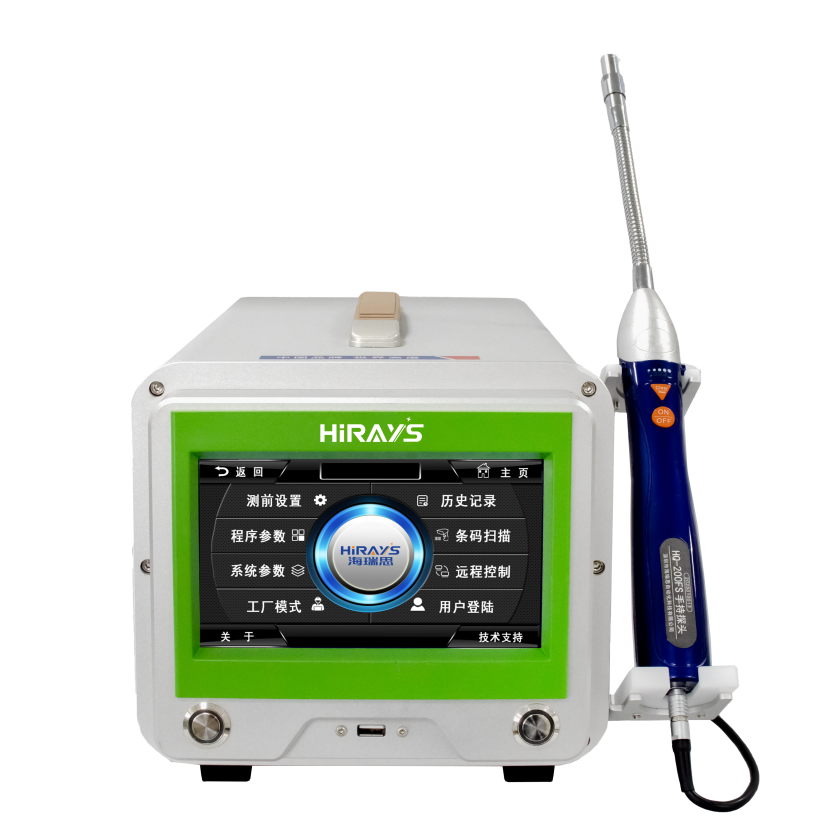
Core advantages of hydrogen and nitrogen leak detection solutions
1. Significant overall cost savings
Low gas cost: The tracer gas is5%hydrogen+95%Nitrogen, the price is much lower than helium, and the supply is stable.
Comprehensive cost advantage: Taking into account gas, equipment depreciation and labor efficiency, the single detection cost of hydrogen and nitrogen leak detection is only about that of helium mass spectrometry leak detection.1/10, which can be as low as a few cents.
2. High precision and strong detection ability
Ultra high sensitivity: The minimum detectable leak rate of the hydrogen-nitrogen leak detector is as low as5×10⁻⁷ mbar·L/s, can stably detect annual leakage of approximately0.1Micro leakage at gram level meets the design requirements of long life and low energy consumption of vehicle refrigerators.
tiny leak“magnifier”: Hydrogen molecules are small and diffuse quickly, and can easily penetrate micropores and microslits that are difficult to find with traditional methods. The detection capability is about 10% higher than that of ordinary air tightness meters.1000times, effectively solving the industry pain point of difficult detection of micro-leakage at capillary welds.
3. Sniffing mode, fast and accurate positioning
Efficient response: The response time of the matching handheld sniffing probe is less than1Seconds, it can follow the operator's movements in real time and quickly find leaks.
Intuitive positioning: Through changes in alarm sound and signal strength, the operator can“follow the signal”, easily find the precise location of the leakage point, greatly improving the rework efficiency and the accuracy of process improvement.
4. Safe and environmentally friendly, easy to integrate
intrinsically safe:5%Hydrogen-nitrogen mixture is not a flammable gas under normal temperature and pressure, complies with safety standards and is friendly to personnel and equipment.
Green and environmentally friendly: Hydrogen is non-toxic and non-corrosive. It is directly discharged after use and has no environmental pollution problems.
Smart integration: Leak detector supportRS232/485and other communication interfaces, which can be easily connected to the production lineMESsystem to realize automatic data recording and tracing, in line with the trend of intelligent manufacturing。