
The cylinder solenoid valve is an industrial device controlled by electromagnetism. It is a basic component of automation used to control fluids. It belongs to the actuator of the cylinder. The solenoid valve can cooperate with different circuits to achieve the expected control, and the accuracy and flexibility of the control can be guaranteed.In order to ensure the safety of the cylinder solenoid valve, manufacturers will perform special waterproof treatment on the shape of the cylinder solenoid valve. The sealing test of the cylinder solenoid valve is also one of its key safety precautions.
Hairis Technology has also conducted in-depth research on the air tightness testing of cylinder solenoid valves and achieved good results, and has put the detector into the production line. This time we will share a case of air tightness testing of cylinder solenoid valves for your reference. We hope it will be helpful to you.
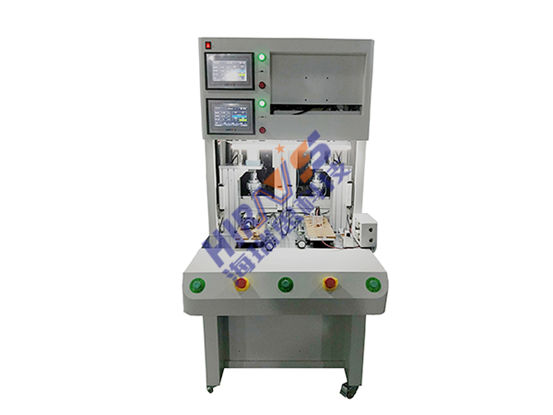
Cylinder solenoid valve air tightness detector
1. Appearance display and detection difficulties of cylinder solenoid valve
1. The cylinder solenoid valve is composed of a cylinder and a solenoid valve. The cylinder to be tested is a cylinder with a guide rod. The front of it is composed of four guide rods parallel to the piston and the cylinder. It has a compact structure, high guidance accuracy, and can withstand large lateral loads and moments.
2. There is a sealed cavity in the solenoid valve, and there is a circular through hole above the solenoid valve. The irregular shape of the external sealing package is not conducive to detection and is not conducive to fixing the solenoid valve with instruments;
3. Since the cylinder solenoid valve is assembled from two different parts, the two parts need to be tested separately, which requires testing instruments.
2. Breakthrough in detection difficulties and operation demonstration of cylinder solenoid valve
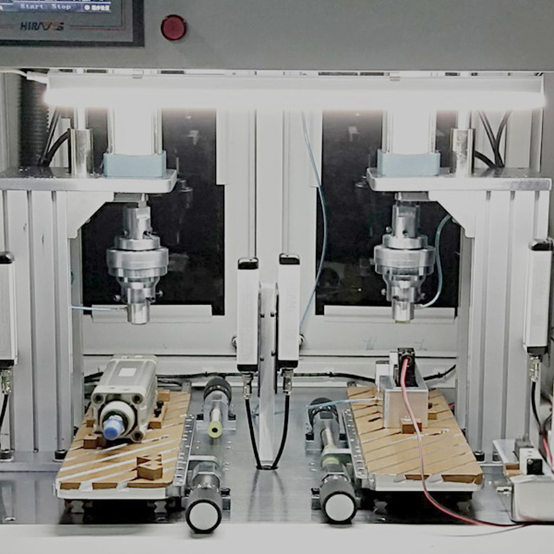
Details of cylinder solenoid valve air tightness testing tooling
1. This time the detection of the cylinder solenoid valve uses a dual-station detector that integrates the station and detector. The pilot series detector has very high flexibility and scalability.With modular design, the control system and execution part are independent.This detection method can realize a system to control multiple execution modules to form a multi-channel test;
2. The cylinder is placed in the inspection mold on the left. Since the air tightness test of the cylinder is relatively special, it is generally not necessary to seal it. The cylinder itself will have a certain amount of leakage.As long as the leakage amount is within the specified range, it is qualified, so it only needs to be directly tested on the cylinder;
3. Due to the particularity of the shape of the solenoid valve, we use a mold to fix it. The lower mold is connected to the conduit connected to the detector. During the test, the upper cylindrical mold blocks the opening of the solenoid valve downwards, and then inputs gas into the solenoid valve. The relative pressure difference method is used to determine the leakage amount, so as to obtain the air tightness of the cylinder solenoid valve.
3. Air tightness detector parameters of cylinder solenoid valve
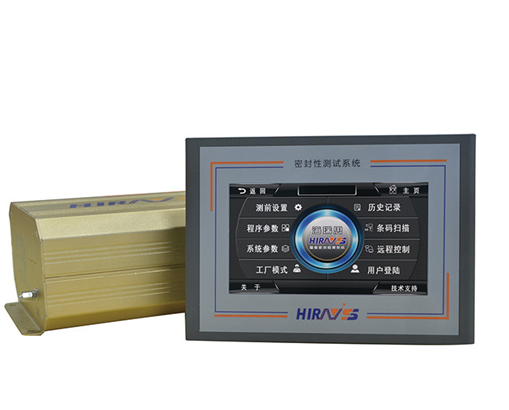
Cylinder solenoid valve air tightness testing instrument
1. High flexibility, functions can be added or deleted according to needs.
2. It has strong scalability and can quickly form multi-channel tests, greatly shortening the automated development cycle.
3. The analysis control system can use various methods such as industrial control computers plus control cards or embedded systems to facilitate the docking and implementation of the MES system.
4. The screen size supports customization, and the embedded system comes standard with 7”Customizable 10.4”12”15”;In industrial control computer mode, the screen size is not limited.
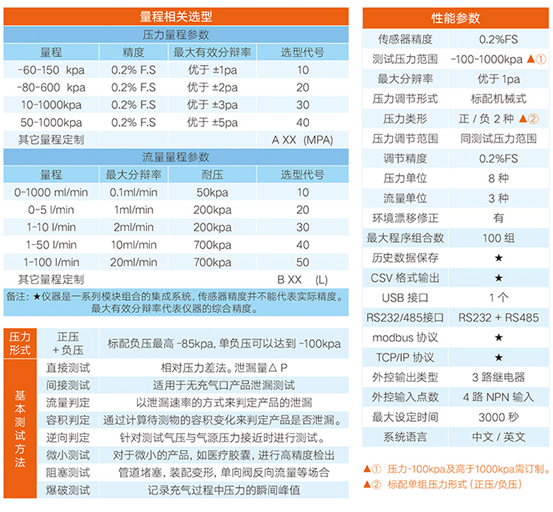
5. The standard configuration adopts the Hairisi full-function valve island, with two pressure forms, positive and negative, and 8 test methods; the two pressure forms and five test methods can be programmed into more than 20 test functions.
The copyright belongs to Hairuis Technology. Reprinting and counterfeit originality are prohibited. Any violation will be at your own risk.