
How to perform a trocar seal test requires understanding the manufacturing method of trocar seals and trocars with them
Generally, the top end of the new umbrella-shaped seal is provided with a mounting hole through which the piercing rod can pass. The diameter of the mounting hole can gradually increase as the seal is stretched along its axial direction.Compared with the previous technology, the new seal is configured to expand the mounting hole when stretched. Therefore, when surgical instruments of different sizes pass through the mounting hole, the thicker the surgical instrument will cause the seal to stretch to a greater extent, thereby making the aperture of the mounting hole adapt to the expansion, so that the force of the surgical instrument remains basically unchanged, avoiding excessive friction during the extraction process of the surgical instrument, and optimizing the sealing performance of the puncture device.
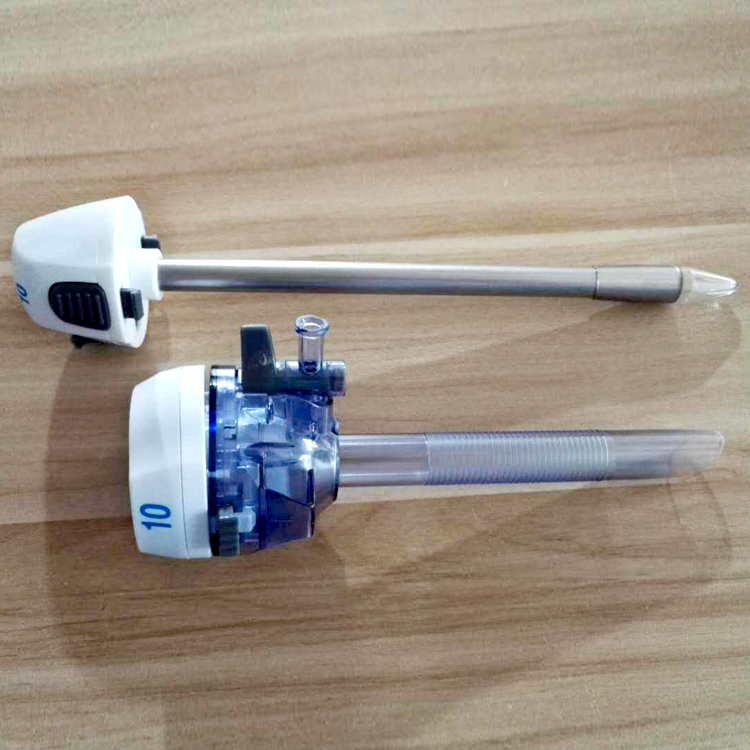
In minimally invasive human medical surgery, once a disease is found in the human body and requires surgery or resection, the first thing that needs to be used during the operation is a puncturer. The puncturer is a surgical instrument that pierces the abdominal wall and allows other surgical instruments to enter the body cavity. It is a minimally invasive surgical instrument.A puncture tool usually includes a sleeve assembly that serves as an entry channel for other surgical instruments and a puncture rod that runs through the sleeve assembly.First, in order to penetrate the skin, first use a scalpel to incise the skin epidermis, then use the puncture rod to penetrate the skin and enter the body cavity together with the sleeve assembly, and then withdraw the puncture rod. The sleeve assembly can be used as a channel to introduce various instruments and tools into the abdominal cavity and provide a channel for raising the abdominal wall of the filling chamber above the organs. In order to prevent various types of injuries during the operationIn case of intra-abdominal gas leakage when instruments and tools are inserted into the abdominal cavity, a sealing component needs to be installed in the sleeve assembly. A common sealing component generally includes a mounting base. The mounting base is provided with a number of sealing pads arranged in a braided manner or circumferentially offset and superimposed. When used, the instrument passes through the center of the sealing assembly composed of multiple sealing pads to achieve a sealing effect.However, the sealing component of the current puncture sleeve has poor sealing effect, and has poor adaptability to surgical instruments of different sizes. It cannot achieve a good balance between the overall air tightness and the ease of passage of surgical instruments. Smaller surgical instruments are prone to air leakage, while larger surgical instruments will produce a large instrument pullout force, and may even cause the entire puncture instrument to fall off the abdominal wall and lose abdominal pressure, affecting the progress of the operation.
Therefore, it is indispensable to use a scientific method to conduct sealing testing and air-tight leak detection on the puncture device.
Since the puncture device is a medical product, it must ensure a very high pass rate.Then the puncture seal detection needs to make the data quantifiable, easy to save, good in stability and high in accuracy, and no misjudgment is allowed.
At present, the better sealing testing equipment is the air tightness testing equipment of Hairuisi Automation Technology Co., Ltd.
This is an air tightness tester that uses gas. It is a testing equipment used for testing sealing performance, waterproof performance, and IPX waterproof testing.It is widely used in medical products, electrical products, household appliances, and other fields.
It is also suitable for the puncture seal test. The puncture seal test is performed using an air tightness detector as follows.
Since the puncture device does not have an air port, it is necessary to make a sealed tooling to prevent the shape of the tool, and then put the puncture device into the tooling. The air tightness detector inflates, stabilizes, and tests the tooling to calculate the amount of air leakage of the puncturer. Based on the amount of air leakage, the sealing performance of the puncturer can be judged, thereby achieving the purpose of testing the sealing of the puncturer.
Due to the unique pneumatic system of Hairis' air tightness testing equipment and the small enough internal space, it is enough to ensure the stability and accuracy of the test. It is equipped with a history recording function and remote control function, and meets the conditions for all puncture seal tests.
